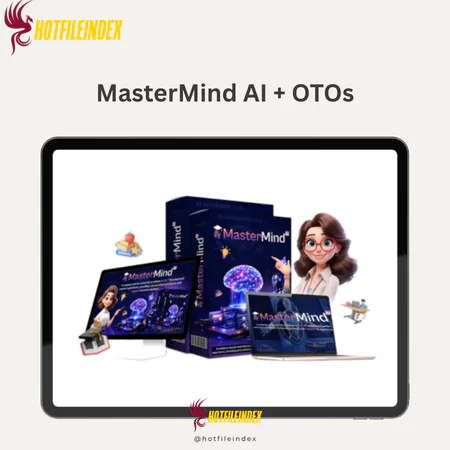
MasterMind AI + OTOs
$15.00
MasterMind AI is an AI platform that creates online courses, trains a personalized AI mentor, and builds basic sales funnels in one place.
You will get Individual Account of
- FE + OTOs
If you looked up “MasterMind AI,” you may have seen it advertised as a platform that uses your knowledge to create classes and AI mentors. This article is not about the idea of “AI-powered masterminds” in general. It is about a particular product—a cloud-based SaaS tool for making online courses, personalized AI coaches, and basic sales funnels.
MasterMind AI has been working with software, tools, and technology for more than 10 years, and we've looked at dozens of platforms just like this one. This article will give you a realistic, experience-based look at what MasterMind AI does, who it's best for, and where it falls short. This guide talks about the following:
What MasterMind AI is and what category of tool it belongs to
- The specific problems it solves for course creators, coaches, and consultants
- How its core workflow operates from idea to a live course
- A breakdown of key features: the AI course generator, Neural Sync–style AI mentor, course portals, and basic funnels
- An honest look at the benefits and limitations
- A side, by, side comparison with other tools and approaches
- Answers to the most common questions readers ask after seeing the product
One important thing to keep in mind right away is that any claims of income or “passive revenue” results from MasterMind AI rest a lot on your audience size, offer quality, traffic, and how well you execute. The tool is just a place to work; it doesn't promise a certain outcome.
Let's start by being clear about what MasterMind AI is and what problem it says it can solve.
What Is MasterMind AI? (Clear Definition and Core Promise)

MasterMind AI is a cloud-based tool that lets you make an online course, train a personalized AI mentor, and set up a basic sales or membership funnel—all without having to write any code. These tasks can be done from a single interface.
The product is a mix of three types: an AI course builder, an AI helper that can be trained, and a light funnel tool. It doesn't ask you to build everything from scratch like most course hosting platforms do. Instead of being a general-purpose chatbot, the AI trainer inside the product has been trained to specifically handle your materials. What MasterMind AI really does is offer a “done-for-you” course with an AI coach and a simple marketing stack.
The smart part of the AI mentor is called a “Course, to, Mentor engine,” which is also sometimes called “Neural Sync.” To put it simply, you give the system your knowledge, like a PDF, a recorded workshop, or a written framework, and it creates an AI persona that can answer student questions in a way that matches your content.
We now understand what MasterMind AI is in theory. Let's look at who uses it and what problems they're trying to fix.
Core Features of MasterMind AI (What You Actually Get)
AI Course Generator
The course generator takes four things as inputs: the topic, the audience you want to reach, the length of time you want the course to last, and any materials you already have. It then creates a structured program. That output has a breakdown of the modules, titles for each lesson, learning goals for each lesson, and suggested tasks or activities.
The most important thing about this is that you keep full editing control. You can accept the plan as is, change parts of it, or tell the system to make a new version of a certain module with different settings. In 2026, people who are working on organized skills training, photography, copywriting, or business frameworks are more likely to get better first drafts than people who are working on topics that are very complicated or sensitive to patients.
The framework for the AI mentor is directly connected to the course generator. Once your lessons are complete, that material becomes the main training data for the AI coaching layer.
Neural Sync–Style AI Mentor (Personalized AI Coach)
MasterMind AI is different from other course hosting platforms because it has an AI instructor. Instead of being a generic chatbot, the mentor is set up with a particular persona, your chosen tone, your area of expertise, and rules for what it will and will not react to. It is also trained on your course content and frequently asked questions (FAQs).
The training sources usually have your finished lesson plans, a list of question-and-answer pairs that you enter by hand, and any frameworks or reference materials you add to the knowledge base. This information is then used by the AI when students ask questions, give replies with varying levels of detail depending on the situation, or ask for more information about a term.
How good these answers are will directly depend on how good and detailed your training data was. Generic outputs come from weak sources. When you give your mentor detailed, well-organized training materials, they will feel really set in your method.
Course Portals, Membership Sites, and Student Experience
As a student, MasterMind AI has a member-facing portal where registered users can log in, view their course modules in order, keep track of their progress, and chat with their AI mentor through a built-in interface.
Support for content formats usually includes text-based lessons, video embeds (hosted outside the app), downloadable files, and simple quiz features. The AI mentor can show up as a chat widget in lessons or as a separate support interface. Where it shows up relies on how you set up the portal.
When a student starts their first lesson, they might log in and see their course dashboard with a module progress indicator. They then open Lesson 1 and read through the structured content. If they have any questions, they can ask the AI guide without leaving the page. That question is answered by what you know, not by a general search on the internet.
Funnels, Landing Pages, and Basic Marketing Automation
The main pages in a course sales flow are already set up in MasterMind AI. There is an opt-in page to collect leads, a sales or offer page to talk about the course, and a finish page to process payment. There are also basic email onboarding routines that are included. These usually include welcome and orientation flows for new students.
| Funnel Element | What MasterMind AI Provides | When You Might Need More |
| Opt-in Pages | Basic templates with copy prompts | Complex multi, step split tests |
| Sales Pages | Pre, structured offer layouts | Deep brand customization |
| Checkout | Integrated payment processing | Multiple payment tiers or complex upsells |
| Email Sequences | Basic onboarding automation | Advanced segmentation or behavioral triggers |
The funnel tools that come with the platform are good for a first start or a simple business with one product. If you have a multi-offer business with segmented email lists or advanced A/B testing, you'll probably find that the default funnel features aren't enough for you. You'll need to add or switch to a dedicated funnel builder like ClickFunnels or a full CRM stack.
Pricing Plans and OTOs detailed
Front End: MasterMind AI – $14.97
- AI-powered platform to build monetized mastermind portals
- Create courses, mentors, and member systems automatically
- Built-in training and support for beginners
- No monthly fees with lifetime access during launch
- 30-day money-back guarantee for risk-free testing
OTO 1: MasterMind AI Unlimited – $37–$47
- Create unlimited portals across multiple niches
- Build unlimited courses, mentors, and members
- Unlock commercial license for client work
- Run multiple income streams simultaneously
- Faster servers and enhanced performance
OTO 2: MasterMind AI Done-For-You (DFY) – $67
- Complete business setup done by the team
- Niche research and funnel creation included
- Ready-to-launch portals and mentors built for you
- Traffic system configured automatically
- Fully operational business within 24 hours
OTO 3: MasterMind AI Automation – $37
- 24/7 automated system for continuous operation
- Automatic content updates and optimization
- Hands-free user onboarding process
- Background system management without manual work
- Keeps business running even when offline
OTO 4: MasterMind AI Traffic Boost – $42–$62
- Access to targeted buyer traffic sources
- Increase visitors and conversion rates
- No need to manage paid ads manually
- Designed for faster income generation
- Boost visibility across offers and funnels
OTO 5: MasterMind AI Agency – $67–$97
- Create and manage 100–400 client accounts
- Offer AI mastermind services to clients
- Set your own pricing and keep full profits
- Centralized dashboard for client management
- Build recurring income from service packages
OTO 6: MasterMind AI Franchise – $62–$92
- Sell the product and keep 100% commissions
- Done-for-you sales pages and funnel included
- Hosting and support handled by vendor
- Promote using your own referral links
- Earn from front-end and upsells
OTO 7: MasterMind AI White Label – $297–$497
- Rebrand the software with your own logo and domain
- Sell under your own company name
- Full control over pricing and positioning
- Launch your own SaaS-style business
- Ownership-level access without development work
Who Is MasterMind AI For and What Problems Does It Solve?
MasterMind AI is for people who know a lot but don't have the time, money, or technical skills to build a full course infrastructure from scratch. The platform is best for small education businesses, coaches, consultants, and people who make courses on their own and need to get an idea to a working product faster than a standard build process can handle.
Now that we are in 2026, the “knowledge economy” has changed to focus on personalized AI interactions. This group still has the same four problems:
- Production Bottlenecks: Building a structured course from scratch usually takes weeks, writing lesson plans, recording content, editing scripts, and organizing modules.
- The Scaling Trap: Once students enroll, keeping them engaged requires answering repeat questions, a task that doesn't scale well for a solo operator.
- Fragmented Tech Stacks: The typical course business requires a course host, a checkout tool, an email provider, and a separate membership platform.
- Content Fatigue: Writing onboarding sequences, quizzes, and worksheets adds yet another layer of production overhead.
Every one of these has an answer that MasterMind AI maps. The AI course generator sets up the basic structure of the curriculum. During breaks from live meetings, the AI mentor handles student Q&A. Because the hub and funnel pages are built in, you don't need as many third-party tools. This makes the road from expertise to a published work shorter and faster.
| Persona | Before MasterMind AI | After MasterMind AI |
| Solo Life Coach | All week spent on 1-on-1 calls; no scalable program. | A group course with an AI mentor handling common client questions. |
| Fitness Trainer | A collection of PDFs and videos sitting unused. | A structured 4-week program with an AI nutrition assistant. |
| Consultant | All revenue tied to billable hours. | A structured framework course operating as a lower-ticket entry point. |
In 2026, many users say they were able to cut the time it took to make a course from weeks to less than 12 hours for a first draft. But the quality of the output depends a lot on how well you tell the system what to do and how much you change the content that it makes later.
If you want to know if MasterMind AI will really work with your workflow, you need to know how it works on the inside. The next part goes over that.
How MasterMind AI Works: From Idea to AI-Powered Course
The general workflow in MasterMind AI follows a seven-step path from topic selection to a live course with an active AI mentor. Understanding this path helps you set realistic expectations before you commit to the platform in 2026.
MasterMind AI has a general workflow that goes through seven steps, starting with choosing a subject and ending with a live course with an AI mentor. If you know about this route, you can set reasonable goals before you commit to the platform in 2026.
Step 1: Choose a topic and define your audience.
The first thing you do is tell the system what and who you want to teach it to. This information changes everything the AI makes after it in 2026, when niche authority is more valuable than general knowledge.
Step 2: Put in what you know
To feed the system, you can use prompts, share files (like PDFs, Docs, and transcripts), or use content links. The quality of the result is better when the input is more organized and specific.
Step 3: The AI makes a course outline.
The system makes a module framework with lesson titles and possible learning goals. You look over this draft and decide which parts to accept, change, or start over.
Step 4: AI adds content to lessons
For each lesson title, body material, scripts, or structured notes are added. This is where you'll spend the most time editing because lesson material made by AI often needs to be checked for accuracy and tone changed.
Step 5: Train the AI Mentor
You feed your finalized course materials, common FAQs, and frameworks into the mentor configuration. The Neural Sync process maps your content to a knowledge base that the AI draws from when answering student questions.
Step 6: Set Up Your Portal and Funnel Pages
You configure the student-facing member area, pricing, access controls, and any landing or checkout pages you need to sell the course.
Step 7: Put it out there and invite students
Students can access the course through the site once it's live, and the AI mentor will handle questions, re-explanations, and suggested answers based on what you've taught it.
A nutrition guide posts the text of her 40-page PDF ebook and the notes she took at three recorded workshops. MasterMind AI makes a course outline with 32 lesson names that is broken up into 8 modules. She checks about 40% of the lesson content for accuracy, sets up her AI mentor with her top 20 client FAQs, and posts within a week—a process that would normally take a month if it were done by hand.
Useful tip: the “first draft structure” part can be finished in less than an hour most of the time. It may take longer to get to a publish-ready state, based on how much editing and review your content needs.
The next step is to break down MasterMind AI's main tools and features so you can see what each one does.
Benefits and Drawbacks of Using MasterMind AI
What Works Well
MasterMind AI has value that can be measured in certain scenarios. In 2026, the speed advantage is a big plus for solo producers and people who are building courses for the first time. After less than 12 hours of work, the first draft of the course format can be ready for review. Usually, this would take two to three weeks of hard work. This compression is very important if you want to make sure an offer is good before putting a lot of money into production.
In the digital economy of 2026, the gap between buy and completion is a big problem that the AI mentor tries to solve. Most students who buy a course stop when they reach a technical or conceptual “sticking point.” An always-on AI mentor that can re-explain concepts, answer frequently asked questions, and send students back to relevant lessons directly targets that point where students stop learning. A lot of operators say they feel like they get better help without having to spend more time on it.
The “Toggle Tax” and other tech costs are also cut down by using a single platform. If someone had to put together a course host, a checkout tool, an email provider, and a basic funnel builder, having all of those features in one place would save them money and make things easier to manage.
Additional benefits include:
- Multi-Product Generation: Create a beginner course, an intermediate program, and an FAQ-based mini-course from the same training materials.
- Rapid Iteration: Test a new module structure or course concept without a multi, week build cycle.
- Low Technical Barrier: If you can type a prompt and upload a file, you can operate the platform.
Where It Falls Short
The most common limitation is the quality of the result. The lesson content that is made by AI usually sounds right at first glance, but it may have gaps, be too simple, or have a tone that doesn't match your voice. Every piece of generated material needs to be reviewed by a person to make sure it meets the standards of 2026 authority.
The AI mentor has the same limitation: the most accurate it can be is based on the data you use to teach it. If you don't know much or use unclear language, the guide will give you answers that aren't on point. One common cautionary situation is starting out with a mentor who isn't very well trained. This can lead to students getting general answers that go against the specific framework taught in the course.
Other limitations to factor in:
- Dependence on a single vendor: Your whole course system is built on a single platform. If prices change or the service goes down, it has a direct impact on your business.
- Funnel Ceiling: The built-in marketing tools work for simple starts, but they don't usually allow for the advanced segmentation or A/B testing that a business that is growing needs.
- Privacy and Compliance: There is a compliance risk when you upload client-sensitive materials or private frameworks to a third-party AI system. Make sure that the way you handle data is in line with GDPR or 2026 AI ethics guidelines.
- Human Connection Risk: An experience that is too automated can feel like a deal. The guide works best when used along with real-life interactions, not instead of them.
How MasterMind AI Compares to Other Tools and Approaches
“Is MasterMind AI the best platform?” is not the best way to compare things because it doesn't get to the heart of the matter. What combination of speed, control, cost, and student experience means most to you in 2026? That's the right question.
As of March 2026, this is how MasterMind AI compares to the four most popular alternatives:
| Option | Speed to Launch | AI Support | Tech Complexity | Monthly Cost | Best For |
| MasterMind AI | Fastest | Integrated AI Mentor | Low | $47+ | Solo creators, fast validation |
| Skool | Fast | Community-led AI | Low | $9 or $99 | Community & Gamification |
| Kajabi / Teachable | Medium | Basic AI Tools | Medium | $89 – $399 | Established brands, deep funnels |
| Mighty Networks | Medium | “Infinite Question” AI | Medium | $49 – $119 | Branded mobile app experience |
| Professional Designer | Slowest | Human Expertise | None (for you) | High (One-time) | Premium, high-ticket programs |
When it comes to people who value community and game-like experiences over complicated course logic, Skool has become the clear leader in 2026. Although Skool is easier to use, it doesn't have the “Neural Sync” feature that lets you train an AI on your own private files. If what you want is a personalized AI coach, MasterMind AI is better. If what you want is community contact, Skool is better.
Both Kajabi and Teachable are mature systems that can be customized more deeply and have stronger SaaS infrastructure. Teachable now has an AI Quiz Generator and Kajabi has advanced funnel builders, but neither of them puts as much emphasis on the AI Mentor as Teachable does as a main student interface. Kajabi gives you more room to grow if you already have a large following and a five-figure monthly budget. MasterMind AI is easier to get into if you are testing your first AI-led deal.
Mighty Networks is the best choice for app makers who want to make a branded app. Their “Infinite Question Engine” and AI-generated course outlines are amazing, but the platform is a lot harder to use than MasterMind AI. If you want a lot of members and automated course delivery, Mighty is the way to go.
Supplemental FAQs About MasterMind AI
Is it a replacement for platforms like Teachable or Kajabi?
Not for all people; for some, yes. MasterMind AI can take care of the most important tasks, like delivering information, letting users interact with it, and managing basic sales flows. Advanced modification, deep API support, and long-term brand control are things that it doesn't do as well as other platforms. A dedicated LMS is still the best choice if you have a large program that needs a lot of control.
Do I need technical skills or coding experience?
There's no need to code. The app is made for people who aren't tech-savvy. You should know how to use computers and be able to send files, fill out configuration forms, and follow a step-by-step setup process. You can use MasterMind AI if you know how to use a Google Doc and a payment service like Stripe.
Can I trust the AI mentor to answer students correctly all the time?
Not without being watched. The AI guide can only be as accurate as the training data it has access to. Even though “contextual intelligence” has gotten better by 2026, AI can still give wrong or incomplete answers if your knowledge base has unclear, sparse, or badly organized material.
The AI tutor should not be seen as the final word, but as a first line of defense. The best things to do in 2026 are:
- Setting clear guardrails in the configuration.
- Testing the mentor with at least 50 representative questions before launch.
- Maintaining a human-in-the-loop process for flagging and correcting “hallucinations” or poor responses.
What types of content work best with MasterMind AI?
Structured, repeatable information is the most useful for sharing. The cleanest AI outputs come from skills-based training (like copywriting, photography, exercise programming, and business frameworks), how-to courses, and coaching programs that focus on the process.
It's harder to automate content that needs a lot of detail, professional judgment, or legal accuracy, like therapy training, advanced medical education, or high-stakes compliance. In these areas, there needs to be more human control to make sure that AI doesn't turn a complicated idea into a dangerous one.
How does the platform handle my data and student privacy?
Data control is a must in 2026 if you want to stay alive. Encryption at rest and in motion is a standard feature of SaaS. But you should make sure of two things in the public privacy policy:
- Model Segregation: Ensure your proprietary data is not used to train the vendor's global models.
- Compliance: For those in higher education or healthcare, verify alignment with GDPR, FERPA, or HIPAA.
Advice from experts: As rules about AI governance get stricter, look for vendors that give you a record of how the AI makes choices.
Is it worth it if I'm just starting and don't have an audience yet?
You can't get people to follow you on the site. A course that no one finds doesn't bring in any money. If you're starting from scratch in 2026, building your audience should be your first goal. This can be done through content creation, community building, and organic search.
But using MasterMind AI early on can help you make sure your deal is good. You can try the idea with a small group of people in less than 12 hours to see if they would actually pay for it before you spend months making a high-quality video.
Can I move my content away later if I switch platforms?
You can move your source material (text, files, and video links) by hand. That being said, the AI mentor is not “portable.” The knowledge base mapping and Neural Sync settings you make are unique to the platform's infrastructure. If you move to Skool or Kajabi, you will have to use your old materials to rebuild that AI teaching layer from scratch.
What are the best alternatives if this isn't a fit?
- For Community & Gamification: Skool (better for engagement, but no custom-trained AI mentor).
- For Full Brand Control: Kajabi or Teachable (proven, mature ecosystems).
- For Mobile App Experience: Mighty Networks (best for branded iOS/Android apps).
- For Technical Ownership: WordPress + LearnDash (lowest recurring cost, highest technical debt).
You should now have a good idea of what MasterMind AI can and can't do for your business in 2026. With all the facts at hand, you can decide what to do next, whether it's to start a trial or do it yourself.
All Info just pre-build when listing. Until Product mark as "Instant Deliver", infomation will be updated again like OTOs you will be get,..etc
Related products

SAAS
SAAS
SAAS


SAAS