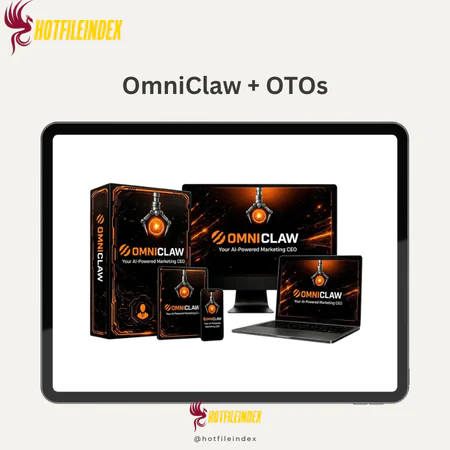
OmniClaw + OTOs
$15.00
OmniClaw is a cloud-based AI marketing platform that uses an AI CEO and specialized agents to create complete marketing campaigns from a single command.
You will get Individual Account of
- FE + OTOs
There is a hidden cost in every multi-tool marketing workflow that rarely shows up in any budget spreadsheet. It is not the subscription fees, though those add up quickly enough. It is the time tax: the hours spent moving between platforms, re-establishing context in each new tool, manually aligning tone and messaging across outputs that were never designed to coordinate with each other, and assembling the final campaign from fragments that originated in four or five completely separate environments.
For a solopreneur or small business owner managing their own marketing, this tax is paid daily. The campaign idea that should take an afternoon ends up consuming three days because the execution layer is fragmented across tools that do not talk to each other.
OmniClaw is built around the proposition that this tax is avoidable. By coordinating a team of more than twelve specialized AI agents from a single plain-English instruction, it attempts to collapse the entire campaign assembly process into one session rather than five separate workflows.
This review examines whether that proposition holds up in practice, what the platform actually delivers at each stage, where the real limitations are, and whether the lifetime pricing makes the investment worthwhile relative to what you are currently spending to achieve the same outcome across a standard tool stack.
What Is OmniClaw?
OmniClaw is a cloud-based autonomous AI marketing platform that uses a multi-agent architecture, anchored by an AI CEO coordination layer, to produce complete campaign assets from a single plain-English instruction. It is not a copywriting assistant, a social media scheduler, or a funnel builder in isolation. It is the campaign director that sits above all of those functions and coordinates their execution in parallel.
The platform is built on an open-source multi-agent foundation called OpenClaw, which gives it a layer of technical credibility that single-purpose AI tools cannot match. Every workflow runs entirely in the cloud with no software installation, no API configuration, and no technical background required. The dashboard is the only interface between the user and the agent team.
The practical entry point is straightforward. You type something like “Create a 5-day email sequence to promote my fitness coaching package to women aged 28 to 45 interested in sustainable weight loss” and OmniClaw's AI CEO distributes the work across agents built for specific tasks. Email copy, subject lines, social captions, landing page copy, and video script elements are produced simultaneously and returned as a coordinated set of first-draft assets.
Front-end access is available at a one-time lifetime price of $14.95 with commercial rights included and a 30-day money-back guarantee. The pricing structure positions OmniClaw as one of the most cost-accessible multi-agent marketing platforms available anywhere in 2026.
The Problem OmniClaw Is Specifically Designed to Solve

Understanding OmniClaw's value requires being precise about the problem it addresses. This is not a problem of AI capability. Jasper, Claude, ChatGPT, and Gemini are all genuinely capable of producing high-quality marketing copy. The problem is orchestration.
A standard marketing workflow for a product launch requires email copy, social media captions, landing page copy, a promotional video script, and potentially a lead magnet or follow-up sequence. Each of these outputs requires a separate session in a separate tool, each of which needs its own context-setting, its own prompt structure, and its own output review process. The outputs then need to be manually aligned for tone, messaging, and offer positioning before any of them are usable as part of a coordinated campaign.
This is the orchestration gap. No single tool in the standard stack covers it. The human operator fills it manually, which is where the three-day campaign assembly timeline comes from for most solo operators.
OmniClaw's AI CEO layer is specifically designed to fill that gap. Rather than requiring the user to orchestrate across tools manually, the AI CEO coordinates the agent team internally, distributing a single instruction across specialized agents that work in parallel and return outputs that share the same messaging foundation.
The result is a compression of the campaign assembly timeline from days to a single session, with all outputs reflecting the same offer, the same audience, and the same brand voice because they all originated from the same coordinated instruction.
Main Features of OmniClaw
AI CEO and Multi-Agent Coordination
The AI CEO is the architectural feature that defines OmniClaw's position in the market. When an instruction is submitted, the AI CEO analyzes it, breaks it into component tasks, assigns each task to the most appropriate specialist agent, and coordinates their simultaneous execution. This parallel processing model is what produces the speed advantage. Agents work at the same time rather than in sequence, compressing what would be a multi-day sequential workflow into a single session output.
The coordination layer also maintains consistency across all outputs. Because every agent receives the same originating instruction and the same brand context, the messaging, tone, and offer positioning stay aligned across email copy, social captions, and landing page content without requiring manual realignment after the fact.
12+ Specialized AI Agents
Each agent in the OmniClaw system is purpose-built for a specific marketing task rather than being a general-purpose AI attempting to cover all output types with equal depth. The agent roster covers email sequence writing, social media caption generation, video script production, landing page and funnel copy, lead generation content, and more. Specialization at the agent level is what allows the platform to produce outputs across multiple formats simultaneously without the quality compromises that come from asking a single model to handle every task type in the same session.
Single Plain-English Instruction Interface
The operational model of OmniClaw is one of its most practically significant features for non-technical users. There is no prompt engineering requirement, no API configuration, and no tool-specific syntax to learn. Users write a structured instruction in plain English covering their offer, audience, channels, tone, and goal, and the AI CEO handles the distribution and execution from there.
The instruction format is accessible enough that first-time AI users can produce usable outputs in their first session. The quality ceiling improves with practice and prompt refinement, but the floor is accessible to complete beginners from day one.
Brand Profile and Context Layer
The brand profile setup completed before any campaign instructions are issued provides the persistent context that shapes every agent output. Niche, tone of voice, audience characteristics, and offer details entered in the brand profile are applied to all outputs without requiring re-specification in every individual instruction. This context layer is what allows the platform to produce brand-consistent outputs across multiple campaigns over time rather than requiring users to rebuild context from scratch in every session.
Template Library for Campaign Fast-Starting
Pre-built templates for common campaign types including basic launches, 7-day promotional sequences, and lead magnet campaigns provide structured starting points for users who are unsure how to frame their first instruction. Templates can be customized to any specific offer or audience, and they serve as prompting frameworks that help new users understand the instruction format before developing their own prompt structures.
Multi-Channel Output Production
A single OmniClaw instruction can generate outputs across multiple marketing channels simultaneously. Email sequences, Instagram and social media captions, landing page and funnel copy, video scripts, and lead generation assets are all producible from one coordinated brief. The cross-channel consistency this produces is one of the hardest things to achieve manually when assembling the same outputs across separate tools.
Commercial Rights and Cloud-Based Access
Front-end access includes commercial rights for client and agency use, making OmniClaw immediately viable as a production tool for freelancers and small agencies without additional licensing overhead. The entirely cloud-based architecture requires no installation and no technical setup, with the dashboard as the sole interface between the user and the agent team.
Pricing Plans and OTOs detailed
Front-End – OmniClaw ($14.95 one-time)
- AI-powered marketing and automation platform with lifetime access
- Includes AI CEO Agent and multiple specialist AI agents
- Supports content creation, funnels, emails, lead generation, and automation
- Includes video tools, image tools, local marketing features, and cloud access
- Comes with Commercial Rights for client and agency use
- Designed for affiliates, freelancers, marketers, agencies, and small businesses
- Includes a 30-day money-back guarantee for risk-free testing
OTO 1 – OmniClaw Unlimited ($67 – $167 one-time)
- Removes restrictions and expands platform capabilities
- Supports larger campaigns, heavier workflows, and more client projects
- Provides a more scalable environment for long-term use
- Designed for marketers and agencies using OmniClaw regularly
- Helps users create and manage more campaigns without limitations
OTO 2 – DFY Money Campaigns ($67 one-time)
- Provides ready-made affiliate-style marketing campaigns
- Includes prebuilt promotional assets and campaign structures
- Helps users avoid starting campaigns from scratch
- Reduces research, planning, and setup time
- Best for beginners and users wanting faster campaign launches
OTO 3 – Chatbot Profit Automation ($37 one-time)
- Adds automated AI chatbot functionality for websites and Telegram
- Helps convert visitors into leads and buyers automatically
- Supports visitor engagement, follow-ups, and lead collection
- Acts as an AI sales and support assistant for offers and pages
- Useful for marketers generating traffic and leads
OTO 4 – Email Profit Automation ($47 one-time)
- Adds automated email-marketing and follow-up systems
- Helps users generate leads and nurture prospects through email
- Supports prospect discovery, campaigns, and automated sequences
- Designed for affiliates, agencies, coaches, eCom sellers, and marketers
- Focuses on long-term buyer relationships and repeat traffic
OTO 5 – Local Profit Automation ($47 one-time)
- Focused on local-business marketing and lead generation
- Helps users find local businesses and identify marketing opportunities
- Supports audits, outreach, proposals, and follow-up automation
- Useful for freelancers, consultants, and local-marketing agencies
- Helps position services around SEO, visibility, and lead generation
OTO 6 – OmniClaw Agency Reseller ($197 one-time)
- Allows users to sell OmniClaw-powered services to clients
- Includes client-account creation and agency-style management
- Lets users charge for AI marketing and automation services
- Supports branding services under your own business name
- Designed for agencies, freelancers, and service providers
OTO 7 – OmniClaw Whitelabel ($297 one-time)
- Lets users fully rebrand OmniClaw as their own software business
- Includes custom branding, logo, colors, and platform positioning
- Allows selling software access under your own brand
- Hosting, updates, and technical support are handled for you
- Designed for entrepreneurs wanting a SaaS-style AI business
- Provides full control over branding, pricing, and customer management
How to Use OmniClaw Effectively
Set Up the Brand Profile First
Before running any campaign instructions, invest time in the brand profile setup. Define your niche with specificity, describe your target audience with demographic and psychographic detail, specify your tone of voice with concrete descriptors, and outline your primary offer. The brand profile is the most important configuration step for output quality because it shapes every agent output across every campaign. Users who complete this step thoroughly report consistently better first drafts than those who approach it as a formality.
Start Small and Specific
The most effective first session involves a scoped, single-channel brief rather than a comprehensive multi-channel campaign. A prompt like “Generate 10 Instagram captions for a handmade jewelry brand targeting women aged 25 to 40, tone: warm and personal” produces an evaluable output set that teaches you how OmniClaw interprets your instructions before you commit to a more complex campaign brief. Starting small gives you a benchmark for prompt quality without the review overhead of a full multi-channel output.
Write Structured Instructions
Prompt quality determines output quality in OmniClaw as directly as in any AI tool. The difference between a vague instruction and a structured one is the difference between a generic draft and something immediately usable. A structured instruction specifies the audience before the ask, names the channels required, includes tone descriptors, details the offer and its key benefits, states the primary conversion goal, and indicates format constraints such as email length or number of social posts. Investing an extra two to three minutes in instruction structure consistently produces outputs that require significantly less editing time.
Review Every Output Before Publication
OmniClaw produces first drafts, not final copies. Every output requires a human review pass covering factual accuracy against your actual offer, brand voice consistency, removal of any claims that do not reflect your real guarantee or product structure, platform compliance for ad copy and email subject lines, and accuracy of any specific details the AI has generated. The review process gets faster as you refine your brand profile and prompt structures, but it should never be skipped entirely regardless of how confident you become in your instruction quality.
Build a Personal Prompt Library
Save the instruction structures that produce the most usable outputs from each session. Over time, this library becomes a starting point for new campaigns that significantly reduces the setup time for each new brief and consistently produces outputs that reflect your evolved brand voice and audience understanding.
Pros and Cons
Pros
- Campaign-level orchestration from a single instruction is the most differentiated capability OmniClaw offers relative to any single-purpose AI tool. The ability to produce coordinated multi-channel outputs from one brief eliminates the manual orchestration overhead that is the primary time cost of standard marketing tool workflows.
- Parallel agent processing compresses a multi-day sequential workflow into a single session, which is the most concrete practical benefit for solo operators who currently spend days assembling campaigns across separate tools.
- Lifetime pricing at $14.95 for the front-end eliminates the recurring subscription cost that accumulates to $1,200 to $3,600 per year across a standard marketing tool stack, making the break-even calculation favorable within the first month for most active users.
- Beginner accessibility through the plain-English instruction format, guided templates, and no-code dashboard makes the platform usable without prompt engineering knowledge or technical configuration skills.
- Commercial rights included in the base purchase allows immediate use for client deliverables without additional licensing overhead.
- Asset consistency across channels maintained through the shared brand context and AI CEO coordination layer produces better cross-channel alignment than manually assembled multi-tool workflows typically achieve.
Cons
- Human review is non-negotiable before publication. The platform accelerates first draft production; it does not replace editorial judgment, factual verification, or compliance review. Every output requires a human pass before deployment.
- Output quality has a direct dependency on instruction quality. The value ceiling is defined by prompt clarity and specificity, which means there is a real learning curve to consistently extracting the platform's best output quality.
- No native email delivery infrastructure. OmniClaw generates email copy but does not send emails or manage subscriber lists. A separate email service provider is required for deployment.
- Cloud-only with data handling considerations. Users working with sensitive client or proprietary business information should review OmniClaw's privacy policy before entering that data into the platform.
- Not a substitute for final visual production. OmniClaw handles copy and creative briefs rather than finished graphic design. Users who need completed visual assets still require a design tool for the final production layer.
Who Should Use OmniClaw?
- Online coaches and course creators whose business model requires regular product launches and promotional campaigns across multiple channels. The 7-day promotional sequence and launch campaign templates directly address the most common campaign type in this category, and the parallel output generation eliminates the multi-day assembly process that most solo course creators currently manage manually.
- Affiliate marketers who need to produce promotional assets quickly for multiple offers and want a faster iteration cycle for testing different campaign angles without the overhead of managing separate tool workflows for each one.
- Solopreneurs managing their own marketing who currently maintain a fragmented tool stack and spend disproportionate time on tool management rather than campaign execution. OmniClaw's consolidation model addresses exactly this workflow.
- Freelancers and small agencies who want to expand their service capacity or accelerate client deliverable production without increasing their monthly subscription overhead. The commercial rights in the base purchase make this viable from day one.
- Non-technical users who find existing AI tools frustrating due to the prompt engineering requirement. OmniClaw's plain-English instruction model and guided templates provide the most accessible entry point to multi-agent AI marketing capability currently available.
Less suited for:
Enterprise teams with brand governance workflows, multi-stakeholder approval processes, or deep proprietary system integrations. Businesses requiring legal review of all content before deployment in regulated industries. Users who need full visual production depth rather than copy and creative briefs.
Frequently Asked Questions
- How is OmniClaw different from simply using ChatGPT with detailed prompts for each campaign element?
ChatGPT is a single-model general-purpose tool that generates one output at a time in response to individual prompts. OmniClaw's AI CEO coordinates 12+ specialized agents in parallel from a single instruction, producing multiple coordinated outputs simultaneously across different content types. The key differences are the parallel processing that compresses timeline, the specialized agent depth for each output type, the persistent brand profile context that applies across all outputs without re-specification, and the campaign-level coordination that maintains messaging alignment across channels. ChatGPT can produce any individual output type that OmniClaw produces, but it cannot orchestrate across all of them simultaneously from one instruction.
- What is the realistic time saving per campaign compared to a manual multi-tool workflow?
For a typical 7-day promotional campaign requiring email sequences, social captions, landing page copy, and a video script, the manual multi-tool workflow typically takes two to five days of execution time for a solo operator managing separate sessions across Jasper, Canva, and an email copy tool. The equivalent OmniClaw workflow from instruction to first reviewable outputs takes 15 to 30 minutes. The review and editing pass adds time proportional to output quality, but even accounting for editing, the total time investment is typically measured in hours rather than days for most campaign types.
- Does the AI CEO feature replace strategic marketing thinking?
No. The AI CEO coordinates task distribution and execution across the agent team based on the instruction it receives. The strategic decisions about offer positioning, audience targeting, campaign timing, and conversion goals remain the responsibility of the human operator. OmniClaw accelerates tactical execution; it does not replace strategic direction. Users who provide well-defined strategic instructions get better tactical outputs. The platform is most valuable when the human operator has clear strategic intent and uses OmniClaw to execute that intent efficiently.
- How does OmniClaw handle campaign consistency across a long promotional period?
Campaign consistency over an extended promotional period depends on the consistency of the brand profile and the instruction structures used across sessions. Users who maintain a detailed brand profile and reuse refined prompt templates from their personal library produce more consistent outputs across multiple sessions than users who approach each session with fresh instructions. The Intelligence layer in OmniClaw applies the brand profile context to every output, but the instruction quality and prompt consistency across sessions are the primary variables that determine long-term campaign voice consistency.
- Is the Whitelabel upgrade suitable for someone wanting to build an ongoing SaaS revenue stream?
The Whitelabel upgrade at $297 provides full platform rebranding capability including custom logo, colors, and positioning, with hosting and technical support handled by the OmniClaw team. It is suitable for entrepreneurs who want to launch a branded AI marketing tool without building the underlying technology themselves. The practical income ceiling depends on the user's ability to acquire and retain software customers, set appropriate pricing, and manage customer relationships effectively. The Whitelabel option removes the product development barrier but retains the go-to-market and sales execution requirements that determine whether any software business succeeds commercially.
- How does OmniClaw compare to open-source multi-agent setups for users with technical backgrounds?
Open-source multi-agent frameworks like the OpenClaw project OmniClaw is built on, and similar GitHub-hosted agent systems, give technically proficient users full control over model selection, data handling, custom integrations, and workflow design. The trade-off is a setup investment of 20 to 80 hours for even an experienced developer to configure a marketing-focused agent system to production quality.
OmniClaw's onboarding takes approximately 15 minutes. For non-technical users or anyone who values their setup time at more than the cost of the lifetime license, OmniClaw's cloud product is the clear practical choice. For developers who require full data control, specific compliance configurations, or custom model routing, the self-hosted open-source path remains the technically superior option at the cost of that configuration investment.
- What happens if the AI produces factually incorrect information about my product?
This is the most important reason why a human review pass is non-negotiable before any OmniClaw output is published. The agents generate content based on the instruction and brand profile context provided, but they do not have access to your actual product specifications, pricing, guarantee terms, or delivery details beyond what you have entered. Any specific claims the AI generates about your product, particularly prices, bonuses, delivery timelines, and guarantees, must be verified against your actual offer before publication. Treat all AI-generated specifics as placeholders that need confirmation rather than accurate representations of your product.
- Can OmniClaw be used to produce content in languages other than English?
OmniClaw accepts plain-language instructions in English and produces outputs in English by default. Outputs can be prompted to incorporate specific regional tones or adapted for translation into other languages as a post-processing step within the workflow. For users whose primary audience uses a language other than English, the most practical approach is to use OmniClaw for the English-language structure and copy framework, then apply translation and localization as a separate editing pass before publication.
- How does the DFY Money Campaigns upgrade differ from standard OmniClaw campaign generation?
The standard OmniClaw platform generates campaign assets from custom user-defined instructions. The DFY Money Campaigns upgrade provides pre-built affiliate-style marketing campaign structures and promotional assets that are ready to deploy without requiring the user to define the campaign from scratch. This upgrade is most valuable for users who want to launch affiliate campaigns quickly without investing time in campaign planning and instruction development, and for beginners who want proven campaign structures as a starting point rather than building their own instruction frameworks from zero.
- What is the most effective way to use the Chatbot Profit Automation upgrade alongside the core platform?
The Chatbot Profit Automation upgrade adds AI chatbot functionality for website and Telegram deployment, enabling automated visitor engagement, lead collection, and follow-up without human operator involvement. Used alongside OmniClaw's core campaign generation capability, the chatbot layer captures leads generated by the campaign assets OmniClaw produces, creating a more complete end-to-end funnel. The most effective integration is to use OmniClaw to create the campaign driving traffic to a landing page, and the chatbot to engage and qualify visitors who arrive at that page, automating the first stage of the conversion conversation.
- How does OmniClaw's output quality compare to a specialist human copywriter for the same campaign?
For straightforward campaign types with well-defined audiences and clear offer positioning, OmniClaw produces first drafts that cover the structural and messaging requirements of a campaign competently. A specialist human copywriter brings strategic insight, creative differentiation, nuanced persuasion frameworks, and the ability to craft genuinely distinctive positioning that AI consistently struggles to match at the highest quality level. OmniClaw is most accurately positioned as a replacement for the functional baseline of campaign copy production rather than a substitute for expert-level copywriting. It produces competent, structurally sound first drafts that a human operator edits and refines, rather than finished copy that requires no human involvement.
- What should a new user focus on in their first week of using OmniClaw to get maximum value quickly?
The first week is most productively spent on three specific activities. First, complete the brand profile thoroughly with specific audience, niche, tone, and offer details before running any campaign instruction. Second, run three to five scoped single-channel briefs rather than one large multi-channel campaign, focusing on evaluating what the platform produces for your specific business context and identifying where the gap between first draft and publishable content is widest.
Third, document the prompt structures that produce the most usable outputs and begin building a personal prompt library. Users who complete these three activities in their first week develop a working understanding of the platform's output quality, its editing requirements, and the instruction structures that consistently produce the best results for their specific business context.
All Info just pre-build when listing. Until Product mark as "Instant Deliver", infomation will be updated again like OTOs you will be get,..etc
Related products
SAAS
SAAS
SAAS
SAAS

SAAS