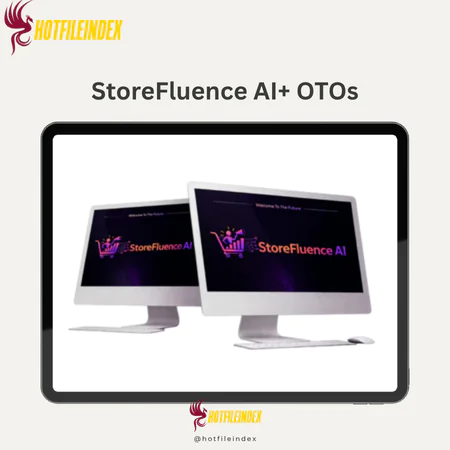
StoreFluence AI + OTOs
$15.00
StoreFluence AI is an all-in-one AI platform that transforms product images into influencer-style video ads and ready-to-sell product pages without editing or coding skills.
You will get Individual Account of
- FE + OTOs
You probably landed here after seeing a launch email, a JVZoo or WarriorPlus offer, a YouTube review, or a social ad promising that AI influencers will sell products for you around the clock. That's the entry point most people have. The pitch sounds attractive, and the questions that follow are predictable: What exactly is this? Does it work? Is it worth the price?
This guide gives you a straight breakdown, no hype, no inflated claims. StoreFluence AI is a cloud-based platform that combines AI video spokesperson generation, viral short-form content creation, and a built-in e-commerce store builder. Those three functions sit inside one tool, marketed toward people who sell products online.
One scenario: you saw a video promising that AI influencers work 24/7, generating sales while you sleep. Another scenario: a marketer in a Facebook group said they produced 20 product videos in one afternoon. Both scenarios reflect what the tool can do, under the right conditions, with the right product and traffic strategy. Results vary based on your niche, your offer quality, and how you drive traffic. No software changes that equation on its own.
This article covers:
- What StoreFluence AI actually is and what it does
- Which user types it fits (and which it doesn't)
- A full breakdown of features and the typical workflow
- An honest look at strengths and limitations
- How it compares to alternative tools
- Answers to the most common questions
First, let's clarify exactly what StoreFluence AI is and what it actually does.
What Is StoreFluence AI?

StoreFluence AI is a cloud-based, all-in-one AI marketing platform that generates hyper-realistic video spokespeople, auto-creates viral-style short-form content, and lets you build and host a simple e-commerce storefront, all without installing software or hiring a production team.
The core idea is traffic-to-sales automation for e-commerce marketers. You bring a product. The platform handles the video script, the AI avatar, the video formatting, and the store page where viewers land after watching. Compared to generic AI tools that handle one function at a time, StoreFluence AI positions itself as a focused system for product promotion, specifically for TikTok, Instagram Reels, and YouTube Shorts.
The three problems it addresses are real ones. Hiring content creators or influencers costs money, often hundreds of dollars per video. Building video production skills takes time. Setting up a separate store, video editor, and content scheduler requires juggling multiple platforms. StoreFluence AI compresses that stack into a single workflow.
A simple example: you upload a skincare product photo, enter a few details about its main benefit, and the platform generates an AI influencer talking about the product, formats the video for TikTok, and links it back to your store page. That's the core loop.
Who Is StoreFluence AI For?
StoreFluence AI targets four main groups, and each gets something specific from the platform. The tool's value depends heavily on which category you fall into and what you need most from it.
| User Type | Main Goal | How StoreFluence AI Helps |
| Drop-shippers | Test winning products fast | Rapid video creatives & a simple product store |
| Affiliates | Drive clicks to affiliate links | AI spokesperson videos with embedded CTAs |
| Store owners | Raise conversion rates and AOV | Product explainer videos and upsell-ready pages |
| Agencies/Freelancers | Sell video and store packages to clients | Commercial license and DFY templates |
Drop-shippers benefit from content velocity, the ability to spin up multiple product videos quickly and test what gets clicks before committing to inventory. Affiliates need a talking face in a video pointing viewers toward a link; AI avatars handle that without requiring the marketer to appear on camera. Store owners with their own products can use the video content on landing pages and product listings to reduce buyer hesitation. Agencies and freelancers with a commercial license can package the output as client deliverables at a service margin.
One condition applies across all four groups: you still need a solid offer, a basic understanding of the platform where you're running traffic, and the willingness to test and adjust. StoreFluence AI speeds up video production; it doesn't replace marketing judgment.
StoreFluence AI Features: Full Breakdown
AI Video Influencer & Avatar Generator
The centerpiece of StoreFluence AI is its AI avatar engine. You input a product image or text prompt, and the system generates a script, selects or builds an AI spokesperson, and produces a lip-synced talking-head video. The platform comes with a library of pre-built AI influencers, different genders, ages, and visual styles, and you can generate custom avatars from a description if the pre-built options don't match your brand context.
Customization covers voice selection, language, video duration (typically 15 to 60 seconds for short-form platforms), and script tone. You can set the tone to urgent, conversational, testimonial-style, or educational depending on what your product and audience respond to. The output files are built for embedding on product pages, sales funnels, and social platforms.
The honest framing here: AI avatars have improved substantially, but discerning viewers can still identify them as AI-generated. For impulse-purchase products on TikTok or Reels, that typically doesn't reduce CTR. For high-trust, relationship-driven niches, it may. Instead of spending $500 or more per video with a real model, you can generate multiple variant videos in minutes, with the trade-off that prompt quality affects output quality. Weak prompts produce weak scripts.
Viral Shorts/Reels Creator for TikTok, Instagram & YouTube
StoreFluence AI includes a short-form video editor built around the formatting requirements of TikTok, Instagram Reels, and YouTube Shorts. The platform handles vertical aspect ratio, short duration constraints, and the structural elements that tend to drive watch time: opening hooks, caption overlays, emoji placements, background music or sound options, and end-card CTAs.
The workflow runs like this: you take the AI influencer clip, apply a preset format for your chosen platform, add a hook in the first 3 seconds (manually adjusting this is worth the extra minute), and attach your store or affiliate link as the CTA destination. The platform can generate multiple creative variations from the same source clip, which is useful for split-testing different hooks or CTAs against each other.
One thing to hold on to: the platform can format your video for virality. It cannot make a weak product or a weak offer go viral. Watch time, CTR, and conversion rates depend on what you're selling and who you're reaching. The tool handles the production layer; the marketing layer is still yours to manage.
Built-In E-Commerce Store Builder & Product Pages
The store builder inside StoreFluence AI is designed for speed and simplicity. You get landing page templates, product pages, basic catalog management, and checkout integration through Stripe, PayPal, or equivalent payment gateways. Setup involves filling out product details, name, price, description, images, stock, and selecting a template. There's no coding involved, the interface uses drag-and-drop elements, and the output is mobile-optimized.
The positioning is accurate: this is a lightweight alternative to full-featured platforms like Shopify or WooCommerce. For a one-product funnel or a quick launch test, you can have a functional storefront live in under an hour. For an established brand with a large product catalog, complex inventory management, multi-currency support, or deep analytics integration, the store builder will feel limiting.
Think of it as an MVP launch tool, not a long-term infrastructure. If you're testing whether a product has demand, it's a practical starting point. If you're scaling past your first 100 orders, you'll likely migrate to a dedicated e-commerce platform and use StoreFluence AI primarily for the video creation side.
Publishing, Integrations & Analytics
StoreFluence AI lets you export finished videos as MP4 files for manual uploading, and the platform supports direct posting or scheduling to major social platforms. You can embed videos on your existing website, funnel pages, or product listings using standard embed codes. For tracking, the platform provides a basic analytics dashboard showing video views, click data, and where possible, conversion signals.
On the integration side, the platform connects conceptually with common marketing infrastructure, email tools, tracking pixels, and UTM parameters for channel attribution. Specific native integrations depend on the version and any upsells purchased, the safest approach is to verify the current integration list on the official page before committing to a higher-tier plan.
A practical workflow: batch-export 10 short videos for a week of TikTok posting, tag each with distinct UTM parameters, and monitor which video drives the most store traffic at the end of the week. That data then informs your next round of content production.
Pricing Plans and OTOs detailed
Front-End – StoreFluence AI ($14.95 one-time)
- All-in-one AI eCommerce and influencer creation platform
- Generate AI influencers, image-to-video content, and built-in stores
- Includes prompt generator and core tools for content + selling
- No monthly fees, pay once for lifetime access
- Beginner-friendly system for content creators and sellers
- Includes a 30-day money-back guarantee for risk-free testing
OTO 1 – Unlimited Edition ($65 – $67 one-time)
- Removes all usage limits across stores, products, and campaigns
- Create unlimited AI influencer videos and marketing assets
- Run more projects and scale without restrictions
- Ideal for users handling multiple products or client work
OTO 2 – Pro Edition ($47 one-time)
- Unlocks advanced eCommerce and marketing features
- Includes voice-based AI influencers and automated store setup
- Adds traffic tools, custom domains, and premium store designs
- Improves branding, conversions, and overall store quality
OTO 3 – Done-For-You (DFY) Edition ($67 one-time)
- Fully set up account with products, influencers, and automation
- Includes ready-to-use store structure and content
- Reduces setup time and technical work
- Best for beginners or users who want faster launch
OTO 4 – AI Workers ($37 one-time)
- Adds 20 AI agents for multi-purpose content creation
- Create websites, funnels, emails, videos, graphics, and more
- Supports SEO, chatbots, social media, and marketing assets
- Ideal for expanding services and boosting productivity
OTO 5 – AI Ranker ($297 one-time)
- Focused on SEO, backlinks, and search visibility
- Helps rank stores, websites, and product pages higher
- Drives organic traffic from search engines
- Suitable for users targeting long-term traffic growth
OTO 6 – Agency Edition ($47 one-time)
- Create and manage unlimited client accounts
- Sell StoreFluence AI as a service and keep the profits
- Includes admin dashboard and payment integration
- Ideal for freelancers and agency owners
OTO 7 – Whitelabel Edition ($47 one-time)
- Rebrand the platform with your own name and domain
- Launch your own AI software business
- Includes hosting, setup, and branding support
- Keep 100% of profits while selling under your brand
How StoreFluence AI Works: Step-by-Step Demo Workflow
From Product Idea to AI Video: A Typical Workflow
Understanding the workflow from start to finish is the fastest way to evaluate whether the tool matches how you actually work. Here's a full run-through using a pet grooming product as the working example.
- Step 1, Define your product and its main benefit. Before touching the platform, get clear on what the product does and who it's for. For a pet grooming brush, the main benefit might be “reduces shedding in 5 minutes.” Clarity at this step improves every output that follows.
- Step 2, Upload your product image or enter a text prompt. Load the product photo or describe the product in the prompt field. The more detail you give, product name, key feature, target audience, the more usable the AI-generated script will be.
- Step 3, Generate or refine the script and select your avatar. The platform produces a draft script based on your input. Review it. AI-generated scripts often need one or two manual edits to sound natural, particularly the opening line, which determines whether viewers keep watching. Select an avatar from the library or generate one that matches your target demographic.
- Step 4, Customize the video. Choose voice, language, duration, hook style, and CTA text. For most short-form content, 15–30 seconds (roughly 30–60 seconds in terms of viewer attention span comparisons) performs better than longer formats. Add your branding if your license includes that option.
- Step 5, Format for your chosen platform. Apply the TikTok, Reels, or Shorts preset inside the viral content editor. Manually adjust the first 3 seconds, the hook, because the automated default is often generic. A specific opening line (“Stop wasting money on brushes your dog hates”) outperforms a vague one every time.
- Step 6, Link the video to your store or affiliate URL. Set the CTA destination to your product page or affiliate tracking link. Test the link before exporting.
- Step 7, Export, publish, and track performance. Download the MP4, post it to your chosen platform, and monitor view duration and click-through rate over the next 48–72 hours. Use that data to decide whether to produce more variations of the same hook or pivot the messaging.
Once familiar with the interface, most users produce a finished video in 15 to 30 minutes. The first few attempts take longer while you calibrate prompt style and hook language.
StoreFluence AI Pros & Cons: Honest 2026 Assessment
Major Advantages
The platform has several concrete advantages, especially for users who are just starting with video-based e-commerce promotion.
- Low barrier to entry for video production. You don't need a camera, editing software, or on-screen presence. Someone with zero production background can produce a platform-ready video within their first session.
- Fast creative iteration. One product idea can turn into 5–10 video variations in an afternoon. For drop-shippers and affiliates testing multiple products simultaneously, this pace matters.
- All-in-one toolset for beginners. Getting a video tool, a store builder, and a content formatter separately adds cost and complexity. For a new marketer, having those functions in one place reduces friction during the setup phase.
- Commercial rights for client work. If the plan includes a commercial or agency license, you can deliver short-form video packages and store builds to clients without additional licensing fees. A freelancer, for example, could use this to offer promo video production for local businesses at a service markup.
- One-time pricing at launch. Compared to monthly subscriptions for AI video tools (which often run $50–$150+ per month), a one-time entry price offers a lower total cost for early adopters, provided the platform continues to receive updates. Always verify current pricing on the official page, as launch pricing changes.
Every tool has trade-offs, and StoreFluence AI is no exception. Knowing the limitations before purchasing is more useful than finding them afterward.
Limitations & Risks
- AI avatars are still identifiable as AI. The gap between AI-generated video and real human footage is narrowing, but it hasn't closed. For brands where authenticity and trust are the primary conversion drivers, coaching programs, high-ticket services, personal brands, AI spokespeople may reduce rather than build credibility.
- Prompt and scripting skill affects output quality. The platform generates content based on your input. Poor prompts produce generic scripts. Users who expect production-ready output with minimal effort often need several iterations before results improve. This is a learning investment, not a one-click process.
- The store builder has a ceiling. It works for launch tests and single-product funnels. Brands that need advanced inventory controls, subscription billing, multi-language storefronts, or deep CRM integration will hit that ceiling quickly.
- Virality is not a product feature. No formatting tool can guarantee that a video reaches a mass audience. Organic reach on TikTok, Reels, and YouTube Shorts depends on content relevance, posting consistency, niche competition, and platform algorithm behavior. StoreFluence AI influences the production layer, the distribution outcome is separate.
- The upsell funnel warrants attention. Like most products sold through JVZoo or WarriorPlus, StoreFluence AI uses a multi-tier OTO (one-time offer) funnel. Buying upgrades without a clear strategy for each is a spending pattern that adds cost without guaranteed proportional return.
- Platform dependency is a real risk. Cloud-based tools depend on continued development and server uptime. Before building a workflow around any single launch product, consider what happens if the tool changes pricing, reduces features, or becomes unavailable. Diversifying your production stack is a sensible long-term approach.
StoreFluence AI vs Alternatives: How Does It Compare?
Direct Competitors: Video AI Tools vs Store Builders
StoreFluence AI occupies a specific position in the market: it combines AI video production and store-building in one tool, but executes both at a lighter level than dedicated platforms in each category. Understanding where it sits relative to alternatives helps you decide whether its combination approach is the right fit.
| Tool Type | AI Video Avatars | Store Builder | Typical Pricing Model | Best Fit |
| StoreFluence AI | Yes | Yes | One-time ($14.95 Front-End) | Beginners and product launch testing |
| AI Video Tools (HeyGen) | Yes | No | Monthly subscription | Brands needing polished, consistent video |
| Shopify-type Platforms | No | Yes | Monthly + app fees | Established e-commerce operations |
| Funnel Builders (ClickFunnels) | No | Yes (funnels) | Monthly subscription | Marketers focused on upsell sequences |
Tools like HeyGen or Synthesia produce higher-fidelity AI video with more customization depth, better lip sync, and wider avatar variety, but they don't build stores and run on monthly SaaS subscriptions. Shopify gives you a full-featured store but no AI video capability, adding video production requires separate tools. Funnel builders handle the conversion architecture but leave content production entirely to you.
StoreFluence AI's advantage is the integrated loop: produce the video and route viewers to a hosted page without switching platforms. Its disadvantage is that neither the video tool nor the store builder reaches the depth of a dedicated solution. If you already pay for HeyGen and Shopify, StoreFluence AI adds little that you don't already have. If you're starting fresh and want one tool to test the concept, it reduces setup time.
When StoreFluence AI Makes Sense (And When It Doesn't)
Use this self-check to decide whether the tool fits your current situation. Score yourself mentally, more “yes” answers on the first list points toward a reasonable fit.
StoreFluence AI is a practical fit if you:
- Are starting out and don't want to manage multiple tools at once
- Need to produce a high volume of test creatives quickly
- Sell products with impulse-purchase appeal (beauty, pets, kitchen, gadgets)
- Want to run short-form video content without appearing on camera yourself
- Have a clear product to test but haven't built a store yet
StoreFluence AI is probably not the right fit if you:
- Already use dedicated AI video tools and an established e-commerce platform
- Need deep inventory management, subscriptions, or multi-language infrastructure
- Operate in a high-trust niche where human influencer authenticity drives sales
- Require advanced video customization beyond what template-based tools offer
The safest approach for any new tool: test it on one product in one niche before restructuring your entire workflow around it. Small-scale validation costs less than an all-in commitment based on a sales page.
Supplemental FAQ: Short Answers to Common StoreFluence AI Questions
What does StoreFluence AI actually do?
StoreFluence AI generates AI spokesperson videos from product images or text prompts, formats those videos for TikTok, Reels, and YouTube Shorts, and provides a hosted e-commerce store for routing viewers to a purchase or affiliate link. The three functions operate inside one cloud-based platform.
Is StoreFluence AI a one-time purchase or a subscription in 2026?
As of 2026, StoreFluence AI is primarily sold at a one-time front-end price (often around $14.95), though higher usage limits and premium features like Unlimited Tier access typically sit behind OTO (one-time offer) upsells. Unlike monthly SaaS tools, it is marketed as a “pay once, use forever” platform.
Can I use StoreFluence AI without showing my face?
Yes. That's one of the primary use cases. AI avatars function as on-screen spokespeople, so the marketer never needs to appear on camera. You select or generate an avatar that matches your target audience and product context.
Does StoreFluence AI guarantee viral videos or sales?
No. The platform optimizes video formatting and production speed. Viral reach depends on content relevance, niche timing, platform algorithm behavior, and posting consistency, none of which a production tool controls. Results vary based on the product, the offer, and how traffic is driven.
Is StoreFluence AI safe and compliant to use on TikTok, Instagram, and YouTube?
The tool itself is a content creation platform. Compliance depends on how you use it. Each platform has policies around AI-generated content and synthetic media disclosures. Review the current community guidelines for TikTok, Instagram, and YouTube before publishing, as policy compliance is the user's responsibility.
Can I use StoreFluence AI for client work?
Yes, if your plan includes the commercial license. This is often included in the front-end or specific agency-tier upsells, allowing you to sell AI influencer clips and store builds to businesses while keeping 100% of the revenue.
StoreFluence AI is a practical production shortcut for social commerce operators who need video content and a product page without a large budget. It's not a passive income machine, and it won't replace the fundamentals of good marketing. Use it to speed up content and store creation, the strategy still sits with you.
All Info just pre-build when listing. Until Product mark as "Instant Deliver", infomation will be updated again like OTOs you will be get,..etc
Related products
SAAS

SAAS
SAAS