


BioRender Lab
$42.00
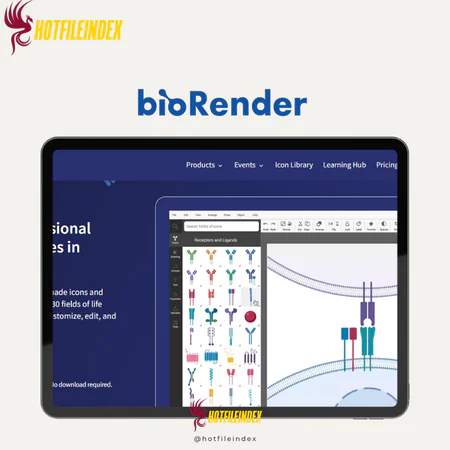
BioRender is an online tool that enables researchers to quickly create accurate biomedical illustrations using ready-made templates
You will get Shared Account of
- FE
In scientific research and the life sciences, the ability to communicate complex concepts clearly is just as critical as the data itself. Visual elements such as figures, diagrams, and schematics often determine whether an idea is quickly understood or easily missed. However, producing professional scientific visuals traditionally requires advanced design skills or lengthy collaboration with designers.
This is where BioRender stands out—closing the gap between scientific accuracy and visual clarity by enabling researchers to create publication-ready figures easily, even without prior design experience.
What is BioRender?

BioRender is an online platform built specifically to help researchers create high-quality biomedical illustrations and figures in minutes. It provides access to a library of more than 20,000 scientifically accurate icons spanning immunology, neuroscience, microbiology, and over 30 additional life science disciplines.
Users can start from pre-designed templates or build custom figures tailored to their needs. If a required icon is missing, it can be requested and is often added within 48 hours. Thanks to its intuitive drag-and-drop editor, BioRender significantly accelerates the process of creating scientific visuals.
Key features

- Large scientific icon library: BioRender includes tens of thousands of scientifically validated icons and illustrations across more than 30 life science fields, all visually consistent and easy to customize.
- Drag-and-drop figure creation: The user-friendly editor allows researchers to assemble professional biomedical figures quickly using simple drag-and-drop actions—no design background required.
- Ready-made templates: A wide selection of pre-built templates helps users get started immediately, while still allowing full customization or the creation of reusable templates.
- Custom icon requests: When specific visuals are unavailable, users can request new icons or upload their own, which can be styled to match BioRender’s visual system.
- AI-powered figure tools: AI-assisted features help generate initial figure drafts, organize layouts, and refine visuals, reducing the time needed to complete figures.
- 3D protein and molecular visualization: Users can import and customize protein structures and molecular models to visually explain complex biological mechanisms more effectively.
- Data visualization tools: Built-in chart and graph features allow experimental data to be displayed alongside illustrations in a single, cohesive figure.
- Collaboration features: Teams can collaborate in real time by sharing figures, leaving comments, and working together—ideal for research labs and group projects.
- High-quality export options: Figures can be exported in high resolution for journals, presentations, posters, print materials, and online use.
Pricing plans

| Plan | Price / Month | Best for | Key highlights |
| Free | $0 | Students, educational use | Limited figures, basic tools, low-resolution exports, templates included |
| Individual | $35 | Individual researchers | Unlimited figures, high-resolution exports, publication-ready images, slides |
| Lab | $99 | Research teams and labs | 5+ seats, team collaboration, shared folders, consolidated billing |
| Institution | Custom pricing | Universities, organizations | SSO access, multi-lab management, custom icons, dedicated support and manager |
Advantages
- Intuitive interface: BioRender’s clean, user-friendly interface is one of its greatest strengths. With straightforward drag-and-drop controls and an organized icon library, figure creation is fast and effortless, allowing scientists to focus on their ideas rather than the software.
- Customization and control: Users can easily modify colors, shapes, and visual elements of icons and illustrations, ensuring figures are precise, accurate, and tailored to specific scientific requirements.
- Extensive illustration library: The platform offers a broad range of icons and graphics covering cellular structures, biological pathways, molecules, and entire organisms.
- Publication-ready output: BioRender produces high-quality, scalable figures suitable for journals and presentations, with crisp exports in formats such as PNG, JPEG, and PDF.
Disadvantages
- Limitations of the free version: While the free plan is a good starting point, it includes notable restrictions. Many icons and features are locked behind paid plans, and continued access to certain assets requires upgrading.
- Restricted image editing capabilities: Although BioRender excels at rapid scientific figure creation, it lacks the advanced image manipulation tools found in professional design software like Adobe Illustrator, which may limit highly detailed custom edits.
Who should use BioRender?
- Life science researchers: Create clear, publication-ready figures for papers, posters, and grant proposals
- Graduate students and PhD candidates: Visualize complex biological concepts for theses, presentations, and coursework
- University professors and educators: Design high-quality teaching materials, lecture slides, and lab visuals
- Biomedical and biotech professionals: Communicate workflows, mechanisms, and research outcomes to teams or stakeholders
- Medical writers and science communicators: Turn complex scientific information into easy-to-understand visuals
- Research labs and teams: Collaborate on figures while maintaining consistent visual standards
- Pharmaceutical and healthcare companies: Illustrate mechanisms of action, pipelines, and research summaries
- Non-designers in science fields: Produce professional scientific illustrations without graphic design skills
FAQs about BioRender
- Can BioRender figures be used in scientific publications?
Yes. Figures created with paid plans can be used in journals, grants, and commercial publications without watermarks, in accordance with BioRender’s licensing terms. - Does BioRender require design skills?
No. BioRender is designed for scientists without design backgrounds, using drag-and-drop tools and ready-made scientific icons. - How many icons and templates does BioRender offer?
BioRender provides access to over 20,000 scientifically accurate icons and thousands of templates across more than 30 life science disciplines. - Can BioRender export high-resolution images?
Yes. Paid plans support high-resolution exports in formats such as PNG, JPEG, and PDF for both print and digital use. - Does BioRender support collaboration?
Yes. Team-based plans allow multiple users to collaborate, share figures, manage folders, and maintain consistent visual standards across labs.
Conclusion
Overall, BioRender is a powerful and practical solution for anyone in the life sciences who needs to communicate complex ideas clearly through visuals.
If you’re looking for a more budget-friendly way to access BioRender or want to avoid committing to the full official subscription, consider purchasing it through Hotfileindex.
| Time | 1 Year |
|---|
All Info just pre-build when listing. Until Product mark as "Instant Deliver", infomation will be updated again like OTOs you will be get,..etc
Related products
Shared
Shared

Shared

Shared

Shared
Shared
Shared

Shared

Shared
Shared