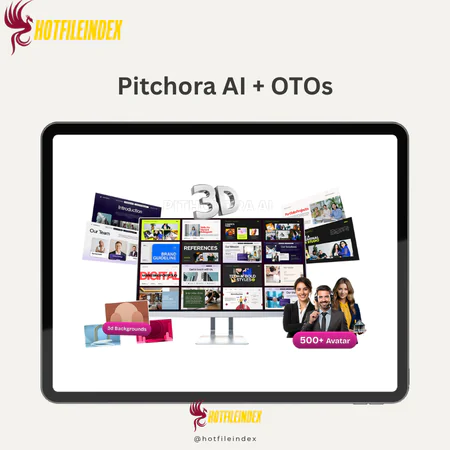
Pitchora AI + OTOs
$37.00
Pitchora AI is an AI-powered sales agent platform that converts sales materials into interactive AI assistants capable of answering objections, engaging prospects, and driving conversions automatically.
You will get Individual Account of
- FE + OTOs
Agencies and freelancers who build sales funnels for clients are familiar with a specific and recurring frustration. You deliver a well-structured funnel, strong copy, and a conversion-optimized page. The client drives traffic. The results are underwhelming. Visitors arrive, browse, and leave without converting, and neither you nor your client knows exactly why because the static page leaves no record of what those visitors were thinking when they decided not to buy.
The missing layer in most client funnels is not better design or stronger headlines. It is the conversational engagement that turns hesitant visitors into confident buyers by answering their specific questions at the exact moment those questions arise. Pitchora AI fills that gap directly. By transforming a client's existing sales materials into an always-on AI pitch agent that handles objections, qualifies prospects, and guides visitors toward conversion, it gives agencies a practical, scalable way to deliver measurably better funnel performance without adding live chat staffing or custom development costs to every client engagement.
What Is Pitchora AI?
Pitchora AI is an AI pitch agent platform that converts existing sales content into interactive, conversational AI agents capable of engaging visitors, answering pre-sales questions, handling objections, and guiding prospects toward a configured call to action around the clock. It is not a generic chatbot or an all-purpose AI assistant. It is a sales-specific conversational tool designed around one clear objective: improving the conversion rate of funnels and sales pages by replacing the passive, static visitor experience with an active, responsive one.
For agencies, the distinction between Pitchora AI and standard chatbot tools matters operationally. A support chatbot is configured around resolving post-purchase issues and reducing ticket volume. Pitchora AI is configured around the client's specific offer, the objections their audience consistently raises, and the conversion actions the funnel is designed to drive. Every element of the platform, from its knowledge base construction to its analytics dashboard, is oriented toward pre-sales conversion rather than customer service.
The platform operates through a straightforward workflow. The agency provides the client's sales materials in one or more formats: a sales page URL, uploaded PDFs or documents, written FAQ responses, and custom text instructions covering specific objections, ideal customer profiles, and brand voice guidelines. Pitchora AI processes those inputs and builds a conversational agent that reflects the client's specific offer rather than generic industry responses. That agent is then deployed across the client's funnel via embed code or shareable link, with a dedicated analytics dashboard tracking conversation performance from day one.
The vendor's established track record in the software and digital tools space provides the platform stability that agencies need when building client deliverables on a third-party foundation. For agencies evaluating whether to build a repeatable Pitchora AI service offering, that track record is a relevant signal alongside the platform's feature set.
How Pitchora AI Works: A Step-by-Step Walkthrough

Step 1: Client Intake and Source Material Preparation
Effective Pitchora AI deployment for client projects begins before opening the platform. The information gathered during client intake directly determines the quality of the configured agent, and a thorough intake process is the single most important factor in agency delivery quality on this type of project.
Key inputs to gather from the client include the full sales page URL or complete sales copy, a comprehensive list of common pre-sales questions and the client's preferred answers, documented objection responses covering the most frequent hesitations their audience expresses, a clear description of the ideal customer profile including their situation, goals, and primary concerns, the client's brand voice guidelines covering tone, terminology, and any language to avoid, and the specific conversion action the funnel is designed to drive, whether that is a direct purchase, a discovery call booking, a free trial sign-up, or another goal.
This intake mirrors the briefing process for any professional copywriting or funnel project. The additional value for Pitchora AI projects is that the same intake materials that inform the agent configuration also give the agency a deeper understanding of the client's offer positioning that benefits the broader funnel strategy.
Step 2: Agent Configuration and Knowledge Base Construction
With client materials in hand, the agent configuration process begins with creating a dedicated project within the Pitchora AI workspace for the specific client offer. Source materials are uploaded or entered across the available input formats, combining the sales page URL with uploaded objection documents and custom written instructions to produce the most comprehensive knowledge model possible from the available content.
Tone and behavioral goal settings are configured to match the client's brand voice and funnel objective. For a client with a formal professional services brand, the agent tone is set accordingly. For a client with a casual, personality-driven course brand, the tone configuration reflects that. Behavioral goals tell the agent what it is working toward in each conversation, ensuring that every interaction is oriented toward the client's specific conversion objective rather than generic helpfulness.
Custom objection responses are added for any question where the client's brand requires a precise, carefully worded answer rather than an AI-generated response. For objections touching on guarantees, refund policies, competitor comparisons, or compliance-sensitive claims, custom configuration is the professional standard rather than an optional enhancement.
Step 3: Multi-Touchpoint Deployment
A single configured agent can be deployed across all relevant touchpoints in the client's funnel simultaneously. The sales page receives the primary deployment where visitor volume and conversion intent are highest. The opt-in confirmation page can carry a pre-sell deployment that primes visitors before they reach the main offer. The checkout page benefits from a last-minute objection handling deployment that addresses hesitations at the point of highest purchase intent. Email sequence links can route warm prospects directly to the conversational pitch experience. Paid ad destinations can use the agent as an interactive landing experience that engages traffic more actively than a static page.
For agencies managing multiple client funnels, this multi-touchpoint deployment model means a single well-configured agent generates value across every stage of the client's funnel rather than requiring separate tool configurations for each touchpoint.
Step 4: Pre-Launch Quality Assurance
Before presenting any Pitchora AI deployment to a client, a structured quality assurance process protects both the client's brand and the agency's professional reputation. The QA process involves conducting test conversations that cover the full range of expected visitor questions, including straightforward information requests, challenging objections, edge case questions outside the core offer content, and the conversion-focused final steps of the conversation flow.
Any response that is inaccurate, tonally off-brand, insufficiently persuasive, or unclear should be addressed through additional source material, custom response configuration, or explicit guardrail instructions before the agent goes live. Presenting a client with an agent that handles their audience's questions poorly is a reputational risk no agency should accept, and the QA investment required to prevent that outcome is modest relative to the damage it prevents.
Step 5: Analytics Review and Ongoing Optimization
After launch, the analytics dashboard provides the performance data that agencies can use both to improve agent performance and to demonstrate value to clients. Conversation volume, engagement rate, conversion events, drop-off points, and top questions and objections ranked by frequency are all visible within the dashboard. This data serves two distinct purposes in the agency relationship. It informs ongoing agent optimization by revealing where visitor questions are not being answered well and where conversation flows are losing prospects. It also serves as a tangible client deliverable, with monthly analytics reports showing conversation performance, the most common visitor concerns, and the optimization actions taken in response, turning what is often an invisible service into visible, documented value.
Key Features of Pitchora AI
AI Pitch Agent Builder
The agent builder is the interface where client sales materials become a functioning conversational agent, and its no-code design means agency teams without developer resources can configure professional-quality pitch agents without technical barriers. The combination of multiple simultaneous input formats, URL analysis, document upload, and custom text instructions, produces knowledge models that are richer and more accurate than any single source alone. For agencies with a structured client intake process, the raw materials for a comprehensive knowledge model are typically already present in the briefing documents and sales assets collected at project start.
The practical delivery efficiency this creates is significant. Where configuring a comparable custom chatbot solution would require developer involvement, custom integration work, and extended setup timelines, Pitchora AI agent configuration is a task that an experienced account manager or funnel specialist can complete independently, which changes the economics and the timeline of offering conversational sales tools as a client service.
Objection Handling and FAQ Automation
Objection handling is where Pitchora AI delivers its clearest commercial value for client funnel performance. The system recognizes common question and objection patterns and responds with configured answers that address each concern specifically while maintaining the client's brand tone. For agencies, the discipline of configuring thorough objection responses for each client agent serves a dual purpose: it produces a better-performing agent and it forces a structured articulation of the client's offer positioning that often surfaces gaps in the existing sales copy that the agency can then address in the broader funnel work.
Custom objection responses for high-stakes questions ensure that the client's most critical pre-sales conversations are handled with precision rather than AI approximation. The combination of AI-powered general question handling for the broad range of visitor inquiries and custom-configured responses for the questions that most directly affect conversion produces an agent that is both flexible and reliably accurate on what matters most.
Guided Selling and Call-to-Action Flows
The guided selling capability allows agencies to configure pitch agents that actively move visitors through a structured selling sequence rather than passively waiting for questions. A well-designed guided flow for a client with multiple offer tiers might open by asking the visitor about their current situation, use their response to identify the most relevant tier, address the most likely objection for that visitor profile, and present a direct CTA link to the appropriate enrollment or purchase page.
For agency clients with complex offers, multiple audience segments, or decision-heavy purchases, this guided approach produces a fundamentally different visitor experience than a static page and a fundamentally different conversion outcome than an agent configured only for passive Q&A. Designing the guided flow during the initial configuration phase, with the client's input on their most important visitor segments and the ideal path through the offer for each, is a high-value strategic deliverable that goes beyond basic agent setup.
Multi-Channel Sharing and Embeds
The deployment flexibility of a single Pitchora AI agent across multiple funnel touchpoints is operationally significant for agencies because it means one configuration investment produces value across the entire client funnel rather than a single page. Embed code compatible with WordPress, Webflow, ClickFunnels, Leadpages, and most other mainstream platforms makes deployment straightforward across the range of technical environments that agency clients typically use.
Standalone shareable links extend deployment beyond embedded pages to email campaigns, paid ad destinations, and social media posts, giving agencies the ability to offer clients an interactive pitch experience across every channel where their audience encounters the offer. For agencies that include multi-channel funnel coverage in their service scope, this deployment flexibility expands what is deliverable from a single Pitchora AI agent configuration.
Lead Capture and CRM Integration
Lead capture configuration within Pitchora AI conversations allows agencies to build lead generation functionality directly into the pitch agent experience, capturing visitor contact information from prospects who are interested but not yet ready to convert and routing that data to the client's CRM or email marketing platform. For high-ticket client offers where the conversion goal is a discovery call rather than a direct purchase, the agent can pre-qualify prospects through conversation and route qualified leads to a booking link, combining the efficiency of automated initial engagement with the relationship-building of a human sales conversation at the appropriate stage.
Compliance with applicable privacy regulations including GDPR and CAN-SPAM is an agency responsibility in the lead capture configuration. Ensuring that explicit consent language is included within the conversational interface before any visitor contact information is collected is a professional and legal standard that agencies should build into every Pitchora AI deployment checklist.
Analytics, Insights, and Optimization Tools
The analytics dashboard is where Pitchora AI generates its most distinct value for agency client relationships beyond the immediate conversion improvement. The data available, covering conversation volume, engagement depth, conversion event rates, drop-off points, and top questions and objections by frequency, provides a qualitatively different picture of funnel performance than standard page analytics. Where page analytics tell you that visitors are leaving, conversation analytics tell you what those visitors were thinking when they left, which transforms the optimization process from guesswork into evidence-based iteration.
For agencies, this data serves as a foundation for monthly client reporting that demonstrates not just that the pitch agent is active but that it is generating actionable insights about the client's offer positioning, their audience's concerns, and the specific questions that are preventing conversion. The visibility this creates into the sales conversation is a genuine service differentiator that many agency clients have never had access to before, making the analytics layer a valuable part of the pitch for the service itself.
User Management, Workspaces, and Agency Features
The workspace and project structure allows agencies to manage multiple client pitch agents within a single account, with each client project maintaining its own source materials, configuration settings, tone guidelines, CTA destinations, and analytics data in complete isolation from other projects. This clean separation makes it operationally practical to manage five, ten, or more client agents without configurations or data interfering with each other, and without the overhead of maintaining separate platform accounts for each client.
Agency-oriented higher-tier features including white-label options, expanded workspace capacity, and client account management tools support the operational model of a professional Pitchora AI service offering, providing the infrastructure for a scalable agency practice built around conversational sales optimization rather than just occasional individual deployments.
Pricing Plans and OTOs detailed
Front-End – Pitchora AI ($37 one-time)
- One-time payment with lifetime access
- AI-powered interactive pitch creation platform
- Create AI sales pitches with lifelike presenters
- Built-in lead capture and visitor engagement tools
- AI-powered question answering and customer interaction
- CRM and prospect management included
- Visitor tracking and analytics tools
- Voice features and interactive 3D-style sales flows
- Commercial license included
- Built for marketers, freelancers, agencies, coaches, SaaS businesses, and affiliates
- Includes 30-day money-back guarantee
- Early-bird launch pricing available
OTO 1 – Pitchora AI Unlimited ($67 one-time)
- Removes core platform limitations
- More workspaces, pitch agents, and lead capacity
- Build unlimited client campaigns and experiences
- Duplicate and scale pitch funnels faster
- Better suited for agencies and service providers
- Designed for scaling AI pitch businesses
OTO 2 – Pitchora AI Enterprise ($47 one-time)
- Build complete customer journey funnels
- Lead capture and appointment booking tools
- Webinar registration and behavior tracking
- Email integrations and smart offer triggers
- Feedback collection and advanced funnel flows
- Unlimited client license included
- Built for agencies and advanced campaigns
OTO 3 – Pitchora AI Leads ($67 one-time)
- Built-in lead discovery and outreach system
- Find businesses and collect contact information
- Outreach and CRM tools included
- Campaign scaling and lead management features
- Saves time on manual prospecting
- Great for freelancers, agencies, and client outreach
OTO 4 – Pitchora AI Automation ($47 one-time)
- Smart CRM and follow-up automation system
- Lead scoring and conversation memory
- Behavior-based triggers and smart replies
- Organize conversations and campaigns from one dashboard
- Team collaboration and lead assignment features
- Built for agencies and multi-client workflows
OTO 5 – Pitchora AI Agency ($67 – $97 one-time)
- White-label AI pitch agency setup
- Create and manage client accounts
- Custom branding, domains, and dashboard setup
- Done-for-you agency materials included
- Client outreach templates, proposals, and contracts
- Supports Fiverr, Upwork, and agency services
- Built for freelancers and agencies
OTO 6 – Pitchora AI DFY ($97 one-time)
- Done-for-you AI pitch setup service
- AI presenter and brand setup handled for you
- CRM and pitch flow configuration included
- Connect forms and automate lead systems
- Saves setup time and avoids technical work
Advantages of Pitchora AI
- Client funnel performance improves through a mechanism that static page optimization cannot address. Stronger headlines, better design, and more compelling copy all improve what a static page says. Pitchora AI improves how the funnel responds to what individual visitors are actually thinking, which is a different and often more impactful lever for conversion improvement.
- The no-code configuration workflow is accessible to non-technical agency team members. Account managers and funnel strategists with strong sales messaging skills can configure and optimize pitch agents without developer involvement, which means Pitchora AI service delivery does not create a new technical dependency within the agency team.
- Conversation data creates a new category of client reporting value. Monthly reports showing the most common visitor questions, the objections preventing conversion, and the optimization actions taken in response represent a level of sales conversation visibility that clients cannot get from any other analytics source, making the reporting a genuine relationship-deepening deliverable rather than a summary of numbers.
- One configured agent covers multiple funnel touchpoints simultaneously. The deployment flexibility across sales pages, email links, checkout pages, and ad destinations means a single configuration investment produces client value across every stage of the funnel rather than one isolated location.
- Objection handling at scale replaces manual pre-sales communication. Client teams that currently spend significant time answering pre-sales DMs, emails, and support inquiries get back that time when a well-configured pitch agent handles those conversations automatically and consistently.
Disadvantages of Pitchora AI
- Agent quality is bounded by the quality of the client's sales materials and offer positioning. The platform amplifies what is already present in the client's content rather than creating persuasive messaging from nothing. Clients with weak or unclear offer positioning will not get strong agent performance regardless of how thoroughly the platform is configured.
- Ongoing monitoring and optimization are genuine operational responsibilities. A Pitchora AI deployment that is configured once and never revisited will degrade in performance as offer details change, new objections emerge, and AI response quality drifts from brand standards. Building regular review and update cycles into the service scope is a professional requirement rather than an optional add-on.
- AI response inaccuracy risk requires structured quality controls. Occasional imprecise or overconfident responses are an inherent characteristic of AI generation that configuration and monitoring reduce but do not eliminate. Agencies that present Pitchora AI as a fully automated, zero-oversight solution are setting incorrect client expectations and accepting avoidable reputational risk.
- Integration depth with proprietary or complex CRM systems may require workarounds. Standard integrations cover commonly used email and CRM platforms reliably. Clients with unusual or highly customized marketing technology stacks should have their specific integration requirements verified against current platform capabilities before Pitchora AI is committed to them as a solution.
- Low-traffic client funnels will not generate sufficient data for meaningful optimization. The analytics-driven optimization loop that makes Pitchora AI most valuable requires sufficient conversation volume to surface reliable patterns. Clients with very low monthly funnel traffic will see limited measurable impact in the short term regardless of how well the agent is configured.
Who Is Pitchora AI For?
- Agencies delivering full-funnel builds for clients with complex offers gain a practical tool for adding conversational sales capability to their deliverable without custom development costs or live chat staffing requirements. The workspace structure, multi-project management, and analytics reporting features are specifically designed for the operational model of a professional agency client relationship.
- Freelance funnel builders and copywriters who manage the complete funnel strategy for individual clients can offer Pitchora AI setup and optimization as a value-added service that extends their engagement beyond the initial build and creates a recurring service relationship built around ongoing agent performance improvement.
- Marketing consultants who include conversion rate optimization in their scope gain a tool that generates the kind of granular visitor behavior data that makes CRO recommendations evidence-based rather than intuition-driven, which strengthens the credibility and impact of the optimization work.
- Small agencies building scalable service offerings around a specific funnel performance methodology can package Pitchora AI as a core component of a repeatable service model, using the platform's project structure to deliver consistent, documented results across a growing client portfolio.
Who Is Pitchora AI Not For?
- Agencies whose client base primarily operates in heavily regulated YMYL categories including medical, financial, and legal services need to approach Pitchora AI deployment in those contexts with significant caution, explicit content guardrails, required human oversight of agent responses, and legal counsel review of all agent configurations before any client-facing deployment.
- Clients with very simple, low-ticket offers that require minimal explanation or persuasion before purchase do not provide enough conversational complexity or conversion leverage to justify the setup and ongoing maintenance investment that professional Pitchora AI deployment requires.
- Agency teams with no capacity for ongoing agent maintenance should not position Pitchora AI as a set-and-forget solution. Clients whose agents are never reviewed or updated after initial deployment will eventually experience performance degradation that reflects poorly on the agency regardless of how strong the initial setup was.
Pitchora AI vs. The Alternatives
| Criteria | Pitchora AI | Generic Support Chatbot | Static Sales Page | Custom GPT Build |
| Primary Design Purpose | Pre-sales conversion | Post-sale support | One-way information | General use |
| Knowledge Source | Client pitch materials | FAQ database | Fixed copy | Broad AI training |
| Objection Handling | Yes, configurable | Minimal | None | Possible, not native |
| Funnel Integration | Native embed | Often add-on | Not applicable | Custom dev required |
| Non-Technical Setup | Yes | Yes | Yes | No |
| Sales-Specific Analytics | Yes | No | Page metrics only | None built-in |
| Agency Multi-Project | Yes | Varies | Not applicable | Custom build needed |
| Lead Capture | Yes, configurable | Sometimes | Form only | Custom build needed |
| Deployment Speed | Hours | Days | Immediate | Weeks |
For agencies evaluating these options against client needs, Pitchora AI wins most clearly when the client needs a sales-specific conversational tool, a non-technical setup timeline, dedicated conversion analytics, and multi-touchpoint deployment without developer involvement. The custom GPT build option becomes more competitive for large agency teams with developer resources and clients whose specific integration requirements fall outside the platform's native capabilities.
Frequently Asked Questions About Pitchora AI
- How does Pitchora AI specifically benefit agencies compared to individual users?
Agencies benefit from the workspace and project structure that allows multiple client pitch agents to be managed within a single account with complete separation between projects. The agency-tier features including expanded workspace capacity, white-label options, and client account management tools support a scalable service model built around conversational sales optimization. The conversation analytics data also provides a new category of client reporting deliverable that individual users managing a single offer do not require at the same operational scale.
- What is a realistic project timeline for setting up a client Pitchora AI agent?
A functional, deployable pitch agent for a straightforward client offer with well-organized existing sales materials can be configured within a half-day of focused work. A comprehensive deployment covering thorough objection configuration, guided selling flows, multi-touchpoint embed setup, lead capture integration, and pre-launch QA testing realistically takes one to two days of dedicated project time. More complex offers with multiple audience segments, extensive objection libraries, and sophisticated guided flow requirements will take longer depending on the scope of configuration needed.
- How should agencies price Pitchora AI services for clients?
Service pricing should reflect the value delivered to the client rather than the cost of the underlying platform. A well-configured pitch agent that measurably improves funnel conversion rates has a business value that is independent of the tool's subscription cost. Many agencies price the initial setup as a one-time project fee and the ongoing optimization and reporting as a monthly retainer, which creates a recurring revenue stream built around documented performance improvement rather than time-and-materials maintenance.
- Can Pitchora AI be white-labeled for client delivery?
White-label and custom branding options are available at higher platform tiers, allowing agencies to present the pitch agent interface and reporting under their own brand identity rather than displaying the underlying platform. This supports the agency's positioning as a strategic conversion optimization partner delivering a proprietary methodology rather than a reseller of a named third-party tool.
- How does the platform handle multiple simultaneous client conversations?
The cloud-hosted SaaS architecture handles concurrent visitor conversations across all deployed agents simultaneously without requiring the agency to manage server capacity or conversation routing. Multiple visitors interacting with different client agents at the same time are handled independently within each project's configured knowledge model and behavioral settings, with conversation data attributed correctly to the relevant client project in the analytics dashboard.
- What ongoing maintenance does a professionally managed Pitchora AI deployment require?
Professional ongoing management typically involves weekly or biweekly conversation log review to identify response quality issues, monthly analytics reporting to the client covering conversation volume, engagement depth, top objections, and conversion events, configuration updates addressing any newly identified objection patterns or offer changes, and periodic review of CTA performance within conversations to ensure the conversion guidance remains aligned with the client's current funnel goals. Building this maintenance scope into the retainer service definition protects both the agent performance and the client relationship.
- How do agencies demonstrate ROI to clients from Pitchora AI deployments?
ROI demonstration typically focuses on three data points available from the analytics dashboard and the broader funnel metrics. Conversation engagement rate shows the proportion of visitors actively interacting with the agent rather than passively browsing. Conversion events tracked within the agent show direct click-throughs to CTAs from conversations. Correlation of funnel conversion rate changes before and after agent deployment, when traffic volume and quality are controlled for, provides the most direct evidence of the agent's impact on overall funnel performance. The qualitative data showing the specific objections being handled and the questions being answered adds context that pure conversion numbers cannot provide.
- Is Pitchora AI suitable for high-ticket client offers?
Yes, with the appropriate scope definition. For high-ticket client offers where the conversion goal is a discovery call or consultation booking rather than a direct purchase, Pitchora AI functions as a pre-qualification and lead preparation layer that handles initial visitor questions, assesses fit through qualifying conversation, and routes qualified prospects to a human sales conversation. The agent should not be positioned as a replacement for the human closer on a high-ticket offer but as the efficient first stage that ensures the human closer's time is spent with pre-qualified, well-informed prospects rather than visitors at the earliest stage of awareness.
- What happens to client data if the agency changes platforms?
Conversation data and analytics history are stored within the Pitchora AI platform and may not be exportable in full depending on current platform export capabilities. Client content including uploaded source materials and custom configuration instructions should be maintained in the agency's own project files independently of the platform, ensuring that agent reconstruction on an alternative platform is possible if required. Establishing this documentation standard as part of the agency's delivery process from the first client project protects against the data continuity risks that any SaaS dependency introduces.
- Can Pitchora AI integrate with the CRM tools most agency clients use?
Standard integrations cover the most widely used email marketing and CRM platforms, and Zapier or webhook connections extend integration options to a broader range of tools. For agencies with clients using common platforms including major email service providers and standard CRMs, native integration coverage is typically adequate. Clients using proprietary, heavily customized, or less common CRM systems should have their specific integration requirements verified against current platform documentation before committing to a Pitchora AI deployment that depends on that integration.
- How does Pitchora AI conversation data improve the agency's broader funnel strategy work?
The conversation data generates qualitative insights about offer positioning and audience concerns that inform the agency's broader strategic recommendations beyond the pitch agent itself. Common visitor questions that the agent handles repeatedly reveal what the sales page is failing to communicate clearly, which becomes a copywriting brief. Frequent objections reveal the specific concerns that are preventing conversion, which informs both agent configuration updates and broader offer positioning adjustments. This feedback loop between agent data and funnel strategy is where the most sophisticated agencies extract value from Pitchora AI that goes well beyond the direct conversion improvement of the agent itself.
- What makes Pitchora AI a sustainable long-term service offering for agencies?
The combination of recurring optimization value, analytics-driven client reporting, and the compounding improvement that comes from regular agent refinement creates a service relationship with natural longevity rather than a one-time deliverable with no follow-on engagement. Clients whose pitch agents are actively maintained and regularly optimized see improving performance over time as the agent's configuration is refined based on real visitor behavior data. That improvement trajectory, documented in monthly reporting, is the foundation of a long-term retained engagement built around measurable, ongoing conversion performance rather than a static deliverable that depreciates after delivery.
All Info just pre-build when listing. Until Product mark as "Instant Deliver", infomation will be updated again like OTOs you will be get,..etc
Related products
SAAS